The Lady Queen by Nancy Goldstone
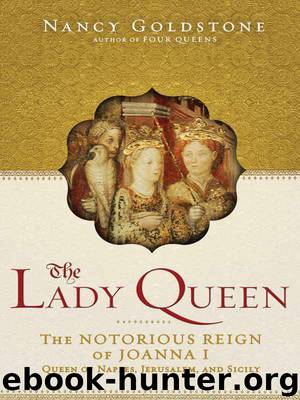
Author:Nancy Goldstone [Goldstone, Nancy]
Language: eng
Format: mobi, epub
Publisher: Bloomsbury Publishing Plc
Published: 2009-11-03T05:00:00+00:00
The lurid termination of this episode marked the end of hostilities between the kingdoms of Naples and Hungary. By the end of October 1350, Louis of Hungary had left Rome for Visegrád, never to return. In February 1351, Louis of Taranto and Niccolò Acciaiuoli came back to the kingdom and liberated Aversa; Joanna and her sister traveled separately by sea. “At the end of the month of February, the king [Louis of Taranto], the queen, and the duchess of Durazzo, reentered the capital city of Naples,” the Chronicon Siculum reported. Despite the clause in the peace treaty, there is no record of Clement’s having convened a new tribunal in order to further investigate Joanna’s role in her first husband’s death. Certainly, she was not required to make an appearance in either Rome or Avignon in order to give evidence again. The Hungarians must have finally given up or lost interest, as the absence of the inquest did not affect the pace of reconciliation. By June 14, Niccolò Ac-ciaiuoli was able to write: “The general accord between our masters and the king of Hungary has been accepted by both sides, the princes are being liberated, and we have peace.” There remained the crippling obligation of the ransom, but even this issue was resolved in Naples’s favor. When on Decem-THE ber 28, 1351, after stalling for months, Joanna finally sent Clement the repayment guarantee he had demanded for agreeing to forward the three hundred thousand florins on her behalf, Louis of Hungary, in a burst of chivalry, surprised everyone by suddenly forgiving the debt, citing as his reason to the pope: “Because he did not go to war for greed, but to avenge the death of his brother,” Matteo Villani explained.
The spring of 1352 was marked by joy and a new spirit of cooperation between Joanna and her husband, an ebullience scheduled to culminate in May with the celebration of an elaborate double coronation. In January, Louis of Taranto had formally agreed to all the limitations to his kingship that Andrew’s family had previously rejected, including the recognition of his wife’s prerogative. He was to be crowned as king consort only; his children by Joanna could inherit the throne (by this time it was known in Naples that little Charles Martel had died) but recognition of his title would not survive her death: if Joanna died without heirs, the kingdom would go to Maria. Robert the Wise’s legitimacy as sovereign was finally fully established, and the hierarchy of succession remained in principle as delineated by his will.
Pleased by Louis of Taranto’s new compliancy, Joanna actively and enthusiastically embraced the notion of a double coronation as a means of stabilizing her relationship with her husband and ensuring the safety and welfare of her kingdom. What she had wanted most was official recognition of her inherited right to rule, and once that issue was resolved, she volunteered to work together with Louis in the interests of reform and unity. There was both a sense of fairness and practicality in this gesture.
Download
This site does not store any files on its server. We only index and link to content provided by other sites. Please contact the content providers to delete copyright contents if any and email us, we'll remove relevant links or contents immediately.
Fanny Burney by Claire Harman(26607)
Empire of the Sikhs by Patwant Singh(23090)
Out of India by Michael Foss(16861)
Leonardo da Vinci by Walter Isaacson(13341)
Small Great Things by Jodi Picoult(7156)
The Six Wives Of Henry VIII (WOMEN IN HISTORY) by Fraser Antonia(5519)
The Wind in My Hair by Masih Alinejad(5103)
A Higher Loyalty: Truth, Lies, and Leadership by James Comey(4967)
The Crown by Robert Lacey(4820)
The Lonely City by Olivia Laing(4808)
Millionaire: The Philanderer, Gambler, and Duelist Who Invented Modern Finance by Janet Gleeson(4482)
The Iron Duke by The Iron Duke(4367)
Papillon (English) by Henri Charrière(4278)
Sticky Fingers by Joe Hagan(4207)
Joan of Arc by Mary Gordon(4117)
Alive: The Story of the Andes Survivors by Piers Paul Read(4037)
Stalin by Stephen Kotkin(3973)
Aleister Crowley: The Biography by Tobias Churton(3646)
Ants Among Elephants by Sujatha Gidla(3470)
